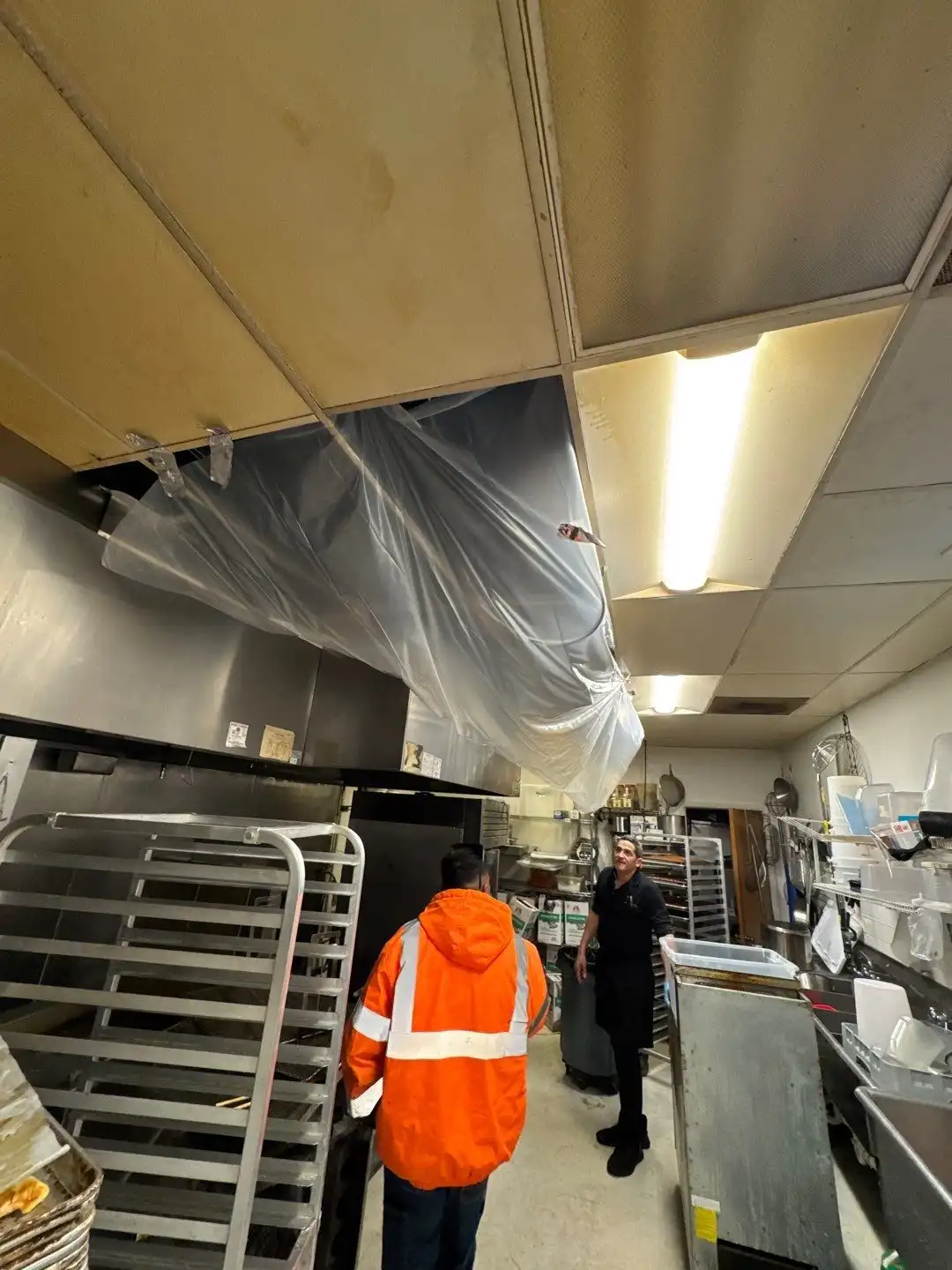
Problem: Water Is Actively Coming Through the Ceiling Right Now
An active interior leak during business hours is the worst kind of call because every minute the water is finding new paths through insulation, deck, and drywall. By the time you see a drip at a light fixture, the water has often traveled fifteen or twenty feet across the deck from the real entry point.
Solution: Stabilize First, Diagnose Second
Our first move is not a repair. It is containment. A crew gets on the roof and tarps or shrink wraps the suspected zone so no more water enters while we trace the actual origin. Inside, we protect finishes and pull wet ceiling tiles before they fall. Only after the building is stabilized do we open the membrane at the true entry point. If you also have interior saturation, we coordinate with our attic water damage from roof leaks process so insulation and framing get dried instead of sealed up wet.
When you call Southport Commercial Roofing with an active leak, severity is assessed over the phone first. We ask where the water is showing, how fast it is coming in, what is directly underneath (electronics, inventory, food prep, server rack), and what the roof type is. That conversation determines whether we dispatch a tarping crew immediately or schedule an inspection for the next available window. Active interior water with electrical risk gets prioritized for dry in ahead of routine work.
Problem: Ponding Water That Will Not Drain
Flat commercial roofs in Southport are designed with slight slope toward drains and scuppers, but over time insulation compresses, decks sag, and drains clog. Standing water adds weight, accelerates membrane breakdown, and voids many manufacturer warranties after 48 hours of continuous pooling.
Solution: Drainage Correction, Not Just Patching
Patching a ponding area without fixing the drainage is throwing money at the symptom. We clear drains and scuppers, add tapered insulation crickets where the deck has settled, and verify slope before any new membrane goes down. On TPO and EPDM systems, we replace the saturated insulation underneath rather than welding a patch over a wet substrate.
We also look upstream at what is feeding the pond. A clogged internal drain on a 20,000 square foot roof can route thousands of gallons toward one low spot during a single storm. Sometimes the fix is as simple as a new drain dome and a strainer basket the maintenance team can clean quarterly. Other times the deck itself has deflected between bar joists and needs structural review before any roofing work makes sense.
Problem: Rooftop Equipment Penetrations That Keep Leaking
HVAC curbs, vent stacks, gas lines, and conduit penetrations are where most commercial leaks start. Every penetration is a hole the roofer has to seal, and every piece of equipment vibrates, expands, and contracts on a different schedule than the membrane around it.
Solution: Rebuild the Detail, Do Not Just Re-Caulk
Pourable sealer pockets and field fabricated boots fail in five to seven years. When we open a chronic penetration leak, we usually find three or four layers of old caulk stacked on top of a flashing that was never right in the first place. The fix is to strip the detail down, install a proper prefabricated boot or rebuild the curb flashing with new termination bar and sealant, and tie it cleanly into the field membrane.
Problem: Pricing That Is Impossible to Compare
You request three bids and get three completely different scopes. One quotes a patch, one quotes a full coating, one quotes replacement. None of them break the work down the same way.
Solution: Line-Item Estimates and a Free Inspection
Every Southport Commercial Roofing commercial estimate breaks out labor, materials, disposal, and any deck or insulation work as separate lines. You see exactly what you are paying for and what we recommend skipping. The inspection is free, and if the building also has interior damage we coordinate with our commercial water damage restoration team so you are not juggling two separate vendors on two separate timelines.
Problem: Storm Punctures and Wind-Lifted Seams
Central Indiana storms bring hail, branches, and straight line winds that lift flashing and tear membrane at the seams. The damage often looks minor from the parking lot and catastrophic once you walk it.
Typical Commercial Roof Repair Price Ranges in Southport
- Small leak patch under 100 square feet: $450 to $1,400
- Seam and flashing repair: $900 to $2,800
- Storm puncture and membrane patch: $1,500 to $4,200
- Ponding correction with tapered insulation: $3,500 to $6,500
- Large section replacement under 1,500 square feet: $5,500 to $8,800
These ranges reflect typical Central Indiana labor, materials, and access conditions. Your actual number depends on roof type, height, rooftop unit density, and damage scope.
Solution: Full Walk and Documented Scope
After a storm, we walk the entire roof, not just the leak area. We photograph every puncture, lifted seam, dented coping, and bruised membrane. That documentation matters for two reasons:
- It gives your insurance carrier the evidence needed to approve a fair claim instead of denying based on wear and tear.
- It prevents the small unseen punctures from becoming next month's emergency call.
We pair this with our commercial roof inspections process when the damage is widespread enough to warrant a full report.
Problem: Failed Seams on Aging Single-Ply Membrane
TPO and EPDM roofs over fifteen years old often fail at the seams before the field membrane itself wears out. UV exposure dries the adhesive, seams shrink, and water tracks under the lap.
Solution: Reweld or Cover Strip, Honestly Assessed
If the field membrane is still pliable and the seams are the only issue, a hot air reweld on TPO or a cover strip on EPDM extends the roof three to seven more years at a fraction of replacement cost. If the membrane has gone brittle and cracks when flexed, we will tell you directly that section repair is buying time at a poor rate of return.
The flex test is something a facility manager can do without a contractor. Walk a corner of the roof on a mild day and press a thumb into the membrane near a seam. Pliable membrane gives slightly and recovers. Brittle membrane feels like cardboard and may show hairline cracks where you pressed. That single check tells you whether you are in repair territory or replacement planning territory.